Grade 9 — De-Streamed Math
A comprehensive foundation in number sense, algebra, linear relations, geometry, data literacy, and financial literacy. Designed for all pathways.
Number Sense & Operations
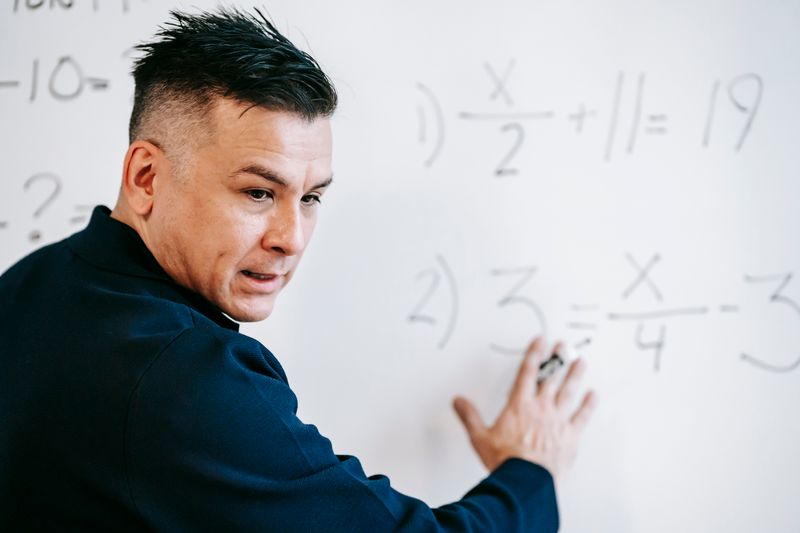
Students compare, represent, and operate with rational and irrational numbers using mental math and estimation strategies. They apply these skills to solve problems involving exponents, roots, and scientific notation.
- Rational vs. irrational numbers
- Integers, fractions, decimals, and percentages
- Order of operations (BEDMAS/PEMDAS)
- Mental math and estimation strategies
- Scientific notation
- Square roots and cube roots
- Applications in real-world contexts
Algebraic Expressions & Equations
Students simplify algebraic expressions, solve linear equations and inequalities, and apply the distributive property. They justify solutions and model real-life scenarios algebraically.
- Simplifying expressions (combining like terms, distributive property)
- Solving one-step and multi-step linear equations
- Solving inequalities and representing solutions on a number line
- Rearranging formulas (e.g., for area, speed)
- Real-world applications (costs, distances)
Linear Relations
Students analyze linear relationships using tables, graphs, and equations. They interpret slope as a rate of change and y-intercept as an initial value in real-world contexts.
- Graphing linear relations from equations, tables, and descriptions
- Calculating slope (rise over run, from graphs and equations)
- y-intercept and its meaning in context
- Writing equations in slope-intercept form (y = mx + b)
- Applications (distance-time graphs, earnings vs. hours)
Measurement & Geometry
Students solve problems involving perimeter, area, surface area, and volume. They explore geometric properties, transformations, and the Pythagorean theorem.
- Perimeter & area of triangles, quadrilaterals, and composite shapes
- Surface area & volume of prisms, pyramids, cylinders
- Pythagorean theorem (solving for missing sides, real-world applications)
- Transformations: translations, rotations, reflections, dilations
- Angle relationships (parallel lines, triangles, polygons)
Data Literacy
Students collect, organize, and analyze data using statistical measures and visual representations. They assess bias and draw evidence-based conclusions.
- Types of data (categorical vs. numerical, discrete vs. continuous)
- Measures of central tendency (mean, median, mode) and spread (range)
- Data visualization (histograms, scatter plots, bar graphs)
- Identifying misleading graphs and bias
- Drawing conclusions from surveys and experiments
Financial Literacy
Students apply math skills to budgeting, interest calculations, and financial decision-making. They compare costs, analyze debt, and plan for future expenses.
- Creating and analyzing budgets (income vs. expenses)
- Simple vs. compound interest (savings, loans, credit cards)
- Financial planning (short-term vs. long-term goals)
- Comparing financial products (bank accounts, loans)
- Understanding credit scores and debt management
Grade 10 — Principles of Mathematics
Academic preparation for university-bound students. Covers linear systems, analytic geometry, quadratic relations, trigonometry, and measurement.
Algebraic Skills & Linear Systems
Students review and extend their understanding of algebraic expressions and equations. They solve systems of linear equations using various methods and apply them to real-world problems.
- Review of linear equations
- Solving systems by graphing, substitution, and elimination
- Applications of linear systems
- Word problems involving systems
Analytic Geometry
Students explore the relationships between equations and geometric representations of lines. They investigate properties of lines and line segments in the coordinate plane.
- Slope and equations of lines
- Midpoint and distance formulas
- Parallel and perpendicular lines
- Applications in geometry and real-life contexts
Quadratic Relations
Students investigate quadratic relations and their properties. They graph and analyze parabolas and solve related problems.
- Characteristics of quadratic relations
- Vertex form and standard form
- Graphing parabolas
- Axis of symmetry and vertex
- Applications of quadratic models
Quadratic Equations
Students solve quadratic equations using a variety of methods and apply these skills to problem-solving situations.
- Factoring trinomials and special products
- Solving by factoring, completing the square, and quadratic formula
- Discriminant and nature of roots
- Word problems involving quadratic equations
Trigonometry
Students explore trigonometric ratios and solve problems involving right triangles. They apply trigonometry to real-world and mathematical problems.
- Sine, cosine, and tangent ratios
- Solving right triangles
- Angle of elevation and depression
- Applications in measurement and design
Measurement & Geometry
Students solve problems involving surface area and volume of 3D figures. They apply geometric reasoning to solve problems.
- Surface area and volume of prisms, pyramids, cylinders, cones, and spheres
- Composite figures
- Optimization problems
- Real-world applications
Grade 11 — Functions (University)
Essential preparation for Grade 12 Calculus and university STEM programs. Covers functions, transformations, quadratics, exponentials, sequences, and trigonometry.
Introduction to Functions
Students explore the concept of a function and distinguish between relations and functions. They represent functions in various forms and understand domain and range.
- Relations vs. functions
- Function notation
- Domain and range
- Evaluating functions
- Graphs of functions
Characteristics of Functions
Students investigate key features of functions and their graphs. They analyze transformations and use function notation to describe changes.
- Intercepts, intervals of increase/decrease
- Maximum and minimum values
- Transformations (translations, reflections, stretches)
- Even and odd functions
- Piecewise functions
Quadratic Functions
Students deepen their understanding of quadratic functions, including their properties, transformations, and applications.
- Vertex form, factored form, and standard form
- Completing the square
- Solving quadratic equations
- Applications of quadratic models
- Optimization problems
Exponential Functions
Students explore exponential growth and decay. They model real-world scenarios using exponential functions and understand their properties.
- Exponential growth and decay
- Base of exponential functions
- Graphing exponential functions
- Applications in finance and science
- Comparing linear, quadratic, and exponential models
Discrete Functions
Students study sequences and series, focusing on arithmetic and geometric patterns. They solve problems involving these sequences.
- Arithmetic sequences and series
- Geometric sequences and series
- Recursive formulas
- Sigma notation
- Applications in real-life contexts
Trigonometric Functions
Students extend their knowledge of trigonometry to include the unit circle and sinusoidal functions. They model periodic phenomena.
- Radian measure
- Unit circle and trigonometric ratios
- Graphs of sine and cosine functions
- Amplitude, period, phase shift
- Applications of sinusoidal models
Grade 11 — Foundations for College Math
Practical mathematics for college and workplace pathways. Focuses on probability, statistics, quadratics, trigonometry, exponents, and personal finance.

Probability
Students explore the concepts of probability and apply them to real-world contexts. They calculate probabilities of simple and compound events and interpret the results.
- Experimental and theoretical probability
- Probability of compound events
- Tree diagrams and organized lists
- Applications in games and real-life scenarios
One-Variable Statistics
Students collect, organize, and analyze data involving one variable. They use statistical measures to interpret and communicate findings.
- Data collection methods
- Measures of central tendency (mean, median, mode)
- Measures of spread (range, interquartile range, standard deviation)
- Histograms and box plots
- Identifying and interpreting trends
Quadratic Relations
Students investigate quadratic relations and their applications. They model and solve problems using quadratic equations.
- Graphing quadratic relations
- Vertex and standard forms
- Solving quadratics by factoring and using the quadratic formula
- Applications in real-world contexts
Trigonometry
Students solve problems involving right and oblique triangles using trigonometric ratios and laws.
- Sine, cosine, and tangent ratios
- Solving right triangles
- Sine Law and Cosine Law
- Applications in measurement and design
Exponents & Exponential Relations
Students explore exponential growth and decay. They model real-world situations using exponential functions.
- Laws of exponents
- Exponential growth and decay
- Graphing exponential functions
- Applications in population growth and depreciation
Compound Interest & Personal Finance
Students apply mathematics to financial decision-making. They explore interest, credit, and budgeting.
- Simple vs. compound interest
- Credit cards and loans
- Budgeting and saving
- Comparing financial services
Grade 12 — Advanced Functions
University preparation for calculus, engineering, and sciences. Deep dive into polynomials, rationals, trigonometry, exponentials, logarithms, and combining functions.

Polynomial Functions
Students explore the characteristics of polynomial functions, including their graphs, equations, and applications. They analyze polynomial expressions and solve related equations and inequalities.
- Characteristics of polynomial functions
- Factoring and solving polynomial equations
- Remainder and factor theorems
- Graphing polynomial functions
- Solving polynomial inequalities
Rational Functions
Students investigate rational expressions and functions. They analyze their properties and solve equations involving rational expressions.
- Simplifying rational expressions
- Identifying asymptotes and discontinuities
- Graphing rational functions
- Solving rational equations
- Applications in real-world contexts
Trigonometric Functions
Students extend their understanding of trigonometric functions and apply them to model periodic phenomena.
- Radian measure and unit circle
- Graphs of sine, cosine, and tangent functions
- Amplitude, period, phase shift, and vertical shift
- Trigonometric identities and equations
- Applications of sinusoidal models
Exponential & Logarithmic Functions
Students explore exponential and logarithmic functions and their applications. They solve equations and model real-world scenarios.
- Laws of exponents and logarithms
- Graphing exponential and logarithmic functions
- Solving exponential and logarithmic equations
- Applications in finance and science
- Comparing exponential and logarithmic models
Combining Functions
Students learn how to combine functions using operations and composition. They analyze the resulting functions and their properties.
- Function operations (addition, subtraction, multiplication, division)
- Composition of functions
- Inverse functions
- Domain and range of combined functions
- Applications in modeling
Grade 12 — Calculus & Vectors
Essential for engineering, physics, and computer science. Covers rates of change, derivatives, optimization, vectors, and 3D geometry.

Rates of Change
Students develop an understanding of average and instantaneous rates of change. They explore the concept of the derivative and its connection to slopes of secants and tangents.
- Average vs. instantaneous rate of change
- Secant and tangent lines
- Introduction to limits
- Derivatives of polynomial functions
- Applications in motion and economics
Derivatives & Their Applications
Students learn rules for finding derivatives and apply them to solve problems involving optimization and motion.
- Derivative rules (power, product, quotient, chain)
- Derivatives of polynomial, rational, radical, exponential, and sinusoidal functions
- First and second derivative tests
- Optimization problems
- Related rates
Curve Sketching & Optimization
Students use derivatives to analyze and sketch functions. They apply calculus to solve real-world problems involving maxima and minima.
- Critical points and inflection points
- Increasing/decreasing intervals
- Concavity and points of inflection
- Sketching curves using derivatives
- Real-world optimization problems
Trigonometric & Exponential Functions
Students extend their understanding of derivatives to include trigonometric and exponential functions and apply them in various contexts.
- Derivatives of sine, cosine, and exponential functions
- Applications in physics and biology
- Modelling periodic and exponential growth/decay phenomena
Vectors in Two & Three Dimensions
Students explore vector operations and apply them to geometric and algebraic problems in two and three dimensions.
- Vector notation and operations
- Scalar and vector components
- Dot product and angle between vectors
- Applications in navigation and physics
Lines & Planes in 3D Space
Students represent lines and planes in three-dimensional space and solve problems involving intersections and distances.
- Vector, parametric, and symmetric equations of lines
- Equations of planes
- Intersections of lines and planes
- Applications in geometry and engineering
Grade 12 — Mathematics of Data Management
Essential for business, social sciences, and health sciences. Covers data organization, statistical analysis, probability, distributions, and culminating investigation.
Organization of Data for Analysis
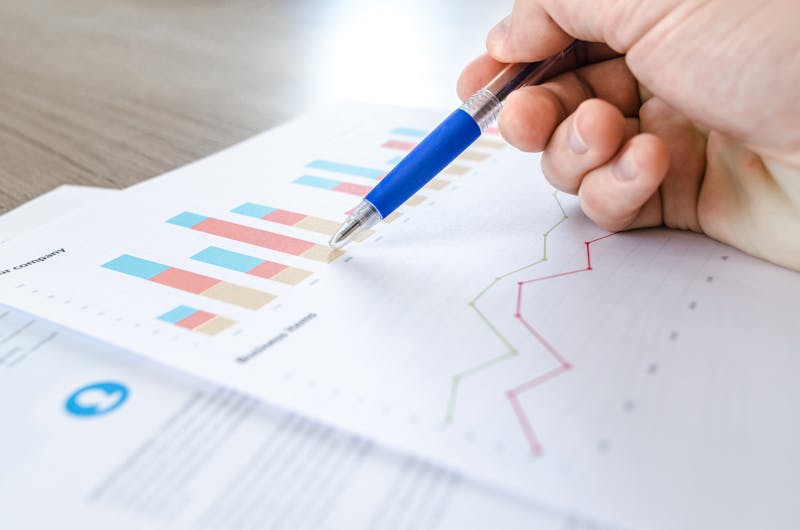
Students learn how to collect, organize, and display data effectively. They explore different types of data and methods of data collection, and assess the validity of data sources.
- Types of data (categorical, numerical, discrete, continuous)
- Data collection methods (surveys, experiments, observational studies)
- Sampling techniques and bias
- Organizing data using tables and graphs
- Evaluating data sources and reliability
Statistical Analysis
Students analyze one-variable and two-variable data using statistical measures and graphical representations. They interpret results and draw conclusions.
- Measures of central tendency and spread (mean, median, mode, range, standard deviation)
- Histograms, box plots, scatter plots
- Correlation and causation
- Linear regression and line of best fit
- Interpreting statistical summaries
Introduction to Probability
Students explore the basic principles of probability and apply them to simple and compound events. They use probability models to make predictions.
- Theoretical vs. experimental probability
- Sample spaces and events
- Venn diagrams and probability rules
- Independent and dependent events
- Conditional probability
Probability Distributions & Predictions
Students investigate discrete probability distributions and use them to model real-world situations. They apply probability to make informed decisions.
- Binomial and normal distributions
- Expected value
- Applications in games, insurance, and risk analysis
- Using technology to simulate and analyze distributions
Culminating Data Investigation
Students conduct a major investigation that integrates data collection, analysis, and interpretation. They present their findings using appropriate mathematical and statistical tools.
- Designing a study or experiment
- Collecting and analyzing data
- Drawing conclusions and evaluating results
- Communicating findings effectively
Not Sure Which Course?
Our free assessment helps identify your child's strengths and gaps. We'll recommend the right tutoring path — no guesswork needed.
Book Free Assessment